Washington, DC
Short, reflective audio experiences designed to be listened to while walking through real places.
Thoughtful audio walks through cities, museums, and ideas
City, Axes, and Symbols
EN10 min-
Place Overview

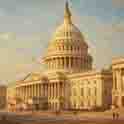
At the U.S. Capitol, the United States comes into view not as a finished monument but as a sequence of improvisations: colonies meeting in Congress, a war directed before there was a permanent executive, a judiciary shaped by statute, and a capital bargained into being on the Potomac. This narration follows the bootstrap of the country itself—how a Congress learned to act nationally, how the name "United States of America" took hold, how Washington was chosen, and how the republic finally gave its new authority an address. Stand with the Capitol long enough and the building begins to feel less like the endpoint of the story than the place where the story first learned how to govern.

Open interactive walkBack to collection
Collection Context
Washington, D.C. — A planned city and power
10 min
You stand in Washington, D.C., a city drawn like a diagram and lived like a story. The grid is calm and rational, but the diagonals cut through it with ambition—avenues that feel designed for ceremony, for procession, for history to have a stage. Around you, monuments act like punctuation in the landscape, insisting on certain memories, certain ideals. The city’s power is not only in what happens here, but in how the place teaches you to see: where the sightlines lead, what gets centered, what becomes background. As you walk, notice how planning becomes symbolism, and symbolism becomes habit. Washington is a blueprint that people keep rewriting, one moment at a time.
The National Mall — A civic stage
10 min
You stand on the National Mall, an open field that behaves like a sentence—inviting additions, revisions, and arguments. It is peaceful at a glance, yet it has carried crowds, grief, celebration, and protest in repeating waves. Here, the nation tells stories about itself in public: not only through monuments, but through the act of gathering. The space feels designed for both reflection and insistence, for quiet looking and collective voice. As you move along the paths, notice how scale changes your emotions. The Mall can make you feel small, then suddenly responsible—like the distance between an ideal and a life is something you’re meant to walk through.
Washington Monument — Myth and verticality
10 min
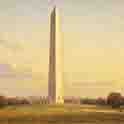
You stand before the Washington Monument, a single vertical idea written in stone. It rises with such simplicity that it feels inevitable—yet it is anything but. The monument pulls your eyes upward, and with them, your thoughts: toward myth, toward origin stories, toward the kind of greatness a nation hopes to claim. Around its base, the city rearranges itself. Sightlines converge, distances feel intentional, and the skyline seems to make room for this one sharp point. As you look up, notice what verticality does to the mind. It can inspire, it can intimidate, it can persuade. The monument asks you to consider how symbols become anchors—and how anchors can steady a story even when the ground keeps shifting.
Jefferson Memorial — Reason and republic
10 min
You stand before the Jefferson Memorial, where white marble curves into a calm geometry of ideals. Across the Tidal Basin, reflections tremble slightly—the monument steady, the water honest about movement. Inside the colonnade, words hover like a second architecture. The language of liberty and reason feels elevated here, yet also complicated by everything that followed: the gap between the clean sentence and the messy nation. As you look around, notice how this place invites two kinds of thought at once: admiration for a vision, and scrutiny of its limits. The memorial is less an endpoint than a prompt—asking what a republic owes to its principles, and what it owes to the people living under them.
The United States — Idea, tension, project
10 min
You stand at a crossroads where history and possibility meet. The United States appears less as a finished monument than as an ongoing project—built from hopes, contradictions, and the stubborn belief that disagreement can be lived through. Listen for the tension between story and reality, between what a nation says it is and what it becomes through choices. Here, ideals are not decorations; they are pressures that test institutions, language, and everyday life. As you reflect, notice how the idea of a country can be both unifying and unresolved. This tour invites you to think of the United States as a living argument—one that keeps asking what freedom, equality, and belonging mean in practice.
How the United States Began — Congress, country, capital
10 min
Current place
At the U.S. Capitol, the United States comes into view not as a finished monument but as a sequence of improvisations: colonies meeting in Congress, a war directed before there was a permanent executive, a judiciary shaped by statute, and a capital bargained into being on the Potomac. This narration follows the bootstrap of the country itself—how a Congress learned to act nationally, how the name "United States of America" took hold, how Washington was chosen, and how the republic finally gave its new authority an address. Stand with the Capitol long enough and the building begins to feel less like the endpoint of the story than the place where the story first learned how to govern.